September 2025
Invasive Species in Lac Pemichangan
In the fall of 2024, the FLP board met with one of Quebec’s foremost experts on milfoil and other invasive species, Dr. Claude Lavoie (Université Laval). He and fellow biologists from RAPPEL (Regroupement des associations pour la protection de l’environnement des lacs et des bassins versants) were loud and clear: if we really want to take steps to protect the lake’s health, we absolutely need to prioritize preventing the introduction of other far more serious invasive species.
Milfoil
The FLP learned a lot from these experts, more than we can convey in this summary, but key points relating to milfoil were:
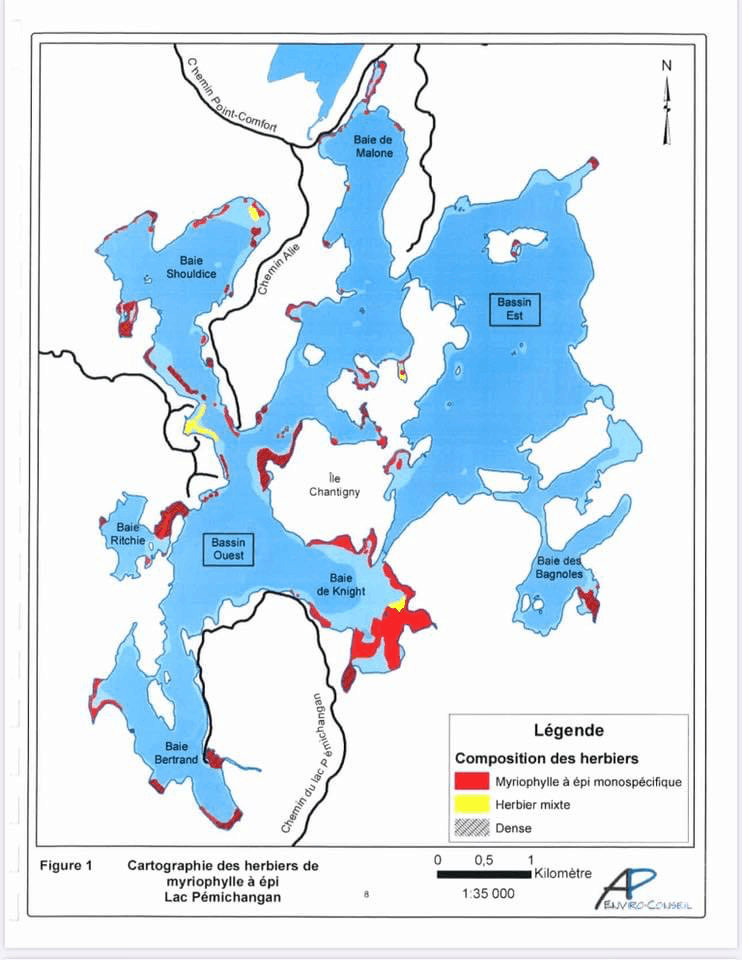
– Although extremely inconvenient and unpleasant, milfoil is not an ecological disaster for the lake.
– You can never completely rid a lake of milfoil once it is present, and the proven milfoil mitigation procedures that exist are complex, very expensive and require annual ongoing efforts. For a lake the size of Pemichangan, initial costs would likely exceed $10 million, with additional ongoing annual costs of approximately $20,000 to keep it at bay.
Zebra Mussels and Spiny Water Fleas
Both zebra mussels and spiny water fleas are invasive species that are getting closer to our area. Both species would have very serious and significant negative impacts on the lake, its fish populations and all the other species that depend upon those fish as a food source. Unlike milfoil, these species would be ecological disasters for the lake.
Pemichangan’s water chemistry – which is rich in calcium – make it particularly vulnerable to zebra mussels. What would an invasion of zebra mussels look like? Zebra mussels colonize rocky shores and dock ladders and are so sharp that people must wear protective footwear to get out of the water. They will also cover the bottom of your watercraft, your docks and water intake pipes blocking them off entirely. Most importantly for lake health, they degrade the micronutrients in the lake to the point that most of the fish and other aquatic species die.
The spiny water flea reproduces quickly and has few predators. Despite its small size, it can significantly modify zooplankton communities by reducing their numbers and causing the disappearance of some species. This can result in overproduction of microscopic algae, lake eutrophication (nutrient overload causing oxygen loss) and a significant decline in fish populations.
Boat Washing is KEY!
The ONLY TOOL we have to prevent these unwanted species from getting into the lake is thorough boat washing of ALL watercraft (including paddle boards, canoes and kayaks) that have been in other bodies of water.
Boat Washing Stations: We now have boat washing stations in Lac-Sainte-Marie and Gracefield. These are a good start to prevent invasive species from entering the lake, but people need to understand how important it is to use them. Please tell your friends, your neighbours and your guests how important boat washing is. Thank your municipality for putting in the boat washing station but ask for better signage, more educational outreach and enforcement. The long-term health of the lake, and of all the species within it, depends on it. Each of us, and the municipal and provincial governments, need to take this very seriously. We all have a role to play.
As our milfoil experience has shown us, we are far better off PREVENTING the introduction of these unwanted hitchhikers into the lake, because once they are here, they are here to stay.
Learn more about Zebra Mussels and Spiny Water Fleas.
2025/26 Trout Spawning Bed Study – Protecting the Trout in Lac Pemichangan
Our conversation on invasive species with Dr. Claude Lavoie (Université Laval) (see above) led us to meet with biologists at RAPPEL (Regroupement des associations pour la protection de l’environnement des lacs et des bassins versants), a non-profit cooperative whose multidisciplinary team works to protect Québec lakes, rivers and wetlands.
Biologists at RAPPEL worked with the FLP Board to write a successful grant proposal to the Fondation de la faune du Québec for $20 000 to study the state of the trout spawning beds in Pemichangan.
Why study lake trout? Lac Pemichangan was previously identified as a trout lake, a designation that, at that time, came with a recommendation of protecting provincial (Crown) land from development. Lake trout are important because they are a sensitive species and an excellent indicator of the health of an aquatic ecosystem. For this reason, ongoing support for the lake trout population remains an important and meaningful way to foster overall lake health and help keep Lac Pemichangan the special place that it is.
For this research, RAPPEL biologists were on the lake in late August and early September to inventory the aquatic plants, including milfoil, surrounding the spawning beds and to examine the degree of silting and health of the lake bottom in these areas. Their final report (due in the spring of 2026) will have recommendations and an action plan for improving any compromised spawning beds, which may include some milfoil mitigation work. The FLP would then pursue further grant applications to implement the action plan.
June 2026
Summary Trout Spawning Bed Study Results.
The inventory of aquatic plants was carried out in the fall of 2025 by RAPPEL biologists at the lake’s spawning grounds (and in adjacent areas) and the milfoil amount was recorded. The lake bottom at the spawning grounds was assessed. The presence of trout was studied when the water was between 6°C and 14°C (43°F and 56°F).
Freshwater green plants (23 species) were seen in the 57 sites surveyed around the five spawning grounds. Milfoil was found in 90% of sites and was the dominant species in 50% of sites. Trout were directly observed at three of five spawning grounds.
The lake trout spawning grounds in Lac Pemichangan generally offer good conditions and no major management actions are required in the short term.
In view of these results, the FLP and its partners will continue to monitor spawning beds (and consider manual removal along the edges) and will disseminate best practices on the reduction of nutrient (phosphates, fertilizers, etc.) input by humans to avoid problems for spawning grounds.